Arts and Science
When artistic creation becomes a research method
In the ARTS project (Agroecology for Resilient Territories in Senegal), CREATES experiments with an approach where the arts are not mere communication tools but genuine methods of research and social transformation. Forum theatre, participatory video, photography, music and slam become spaces where scientific and popular knowledge intersect, where new knowledge and shared visions of the future emerge.
Beyond communication: art as method
For CREATES, art is not an aesthetic supplement added at the end of a process. It is a mode of knowledge in its own right - what we call "artcipation". When a community stages its land conflicts through forum theatre, it is not "communicating" a research finding: it is producing knowledge, by revealing power dynamics, unspoken tensions and aspirations that neither a questionnaire nor a focus group could capture. Art creates a space of parity of participation where every voice - the researcher's, the farmer's, the village chief's - finds its legitimacy. It is an engaged science that embraces its political dimension.
The ARTS project
ARTS (Agroecology for Resilient Territories in Senegal) is a transdisciplinary research project funded by the SOR4D programme. It articulates three research lines: land system science, food system governance and feminist agroecology. At the heart of the approach, arts-based methods enable us to go beyond the limits of conventional participation. The project builds on the DyTAEL platforms (Dynamique pour une Transition Agroécologique Locale) as spaces of co-construction between researchers, communities and territorial actors.
Transformative scenarisation
Transformative scenarisation is a method developed within the ARTS project, structured around three key moments over three days. The first day is devoted to systemic problem analysis: participants collectively identify the key issues facing their territory - land access, soil degradation, women's exclusion, urban pressure. On the second day, these problems take shape on stage through forum theatre: actors from the Kareng Company of Ziguinchor stage the problematic situations, then spectator-actors step onto the stage to propose alternatives. On the third day, building on this shared experience, participants co-construct a collective vision and a roadmap for their territory.
Forum theatre: a political and epistemic tool
Inspired by Augusto Boal's Theatre of the Oppressed, forum theatre as practised by CREATES is both a political tool and a knowledge-production tool. On stage, power relations become visible and contestable. A farmer can embody a land speculator, a woman can replay a municipal council scene from which she is usually excluded, and propose a different outcome. In doing so, participants do not merely represent reality: they re-interrogate it and imagine other possibilities. The knowledge that emerges from this process is irreducible to that of a conventional survey - it is embodied, situated, and transformative.
Three approaches, one horizon
The ARTS project experiments with three complementary approaches. Transformative Scenarisation, developed with the DyTAEL platforms, combines systemic analysis and forum theatre to build shared territorial visions. Mix Collective Creation, tested in Bignona, brings together researchers, communities and artists in a shared creative process where each participant contributes to the scenario. Women's Community Creation, conducted in Mlomp in Casamance, offers an exclusively female space where women stage their realities - domestic work, land access, mental load - through artistic forms they freely choose.
The Mbour workshop: agroecology on stage
In February 2025, the workshop "Agroecology on Stage" brought together actors from the DyTAEL platform of Mbour for three days of transformative scenarisation. Five thematic groups worked on the critical issues facing their territory: land management in the face of urbanisation, degradation of coastal ecosystems, women's access to productive resources, governance of local food systems, and transmission of agroecological knowledge. The Kareng Company accompanied each group in staging their issues, before spectator-actors stepped onto the boards to propose concrete alternatives. These three days produced a shared vision and a territorial action plan rooted in lived realities.
The AgroVoices Photographic Exhibition
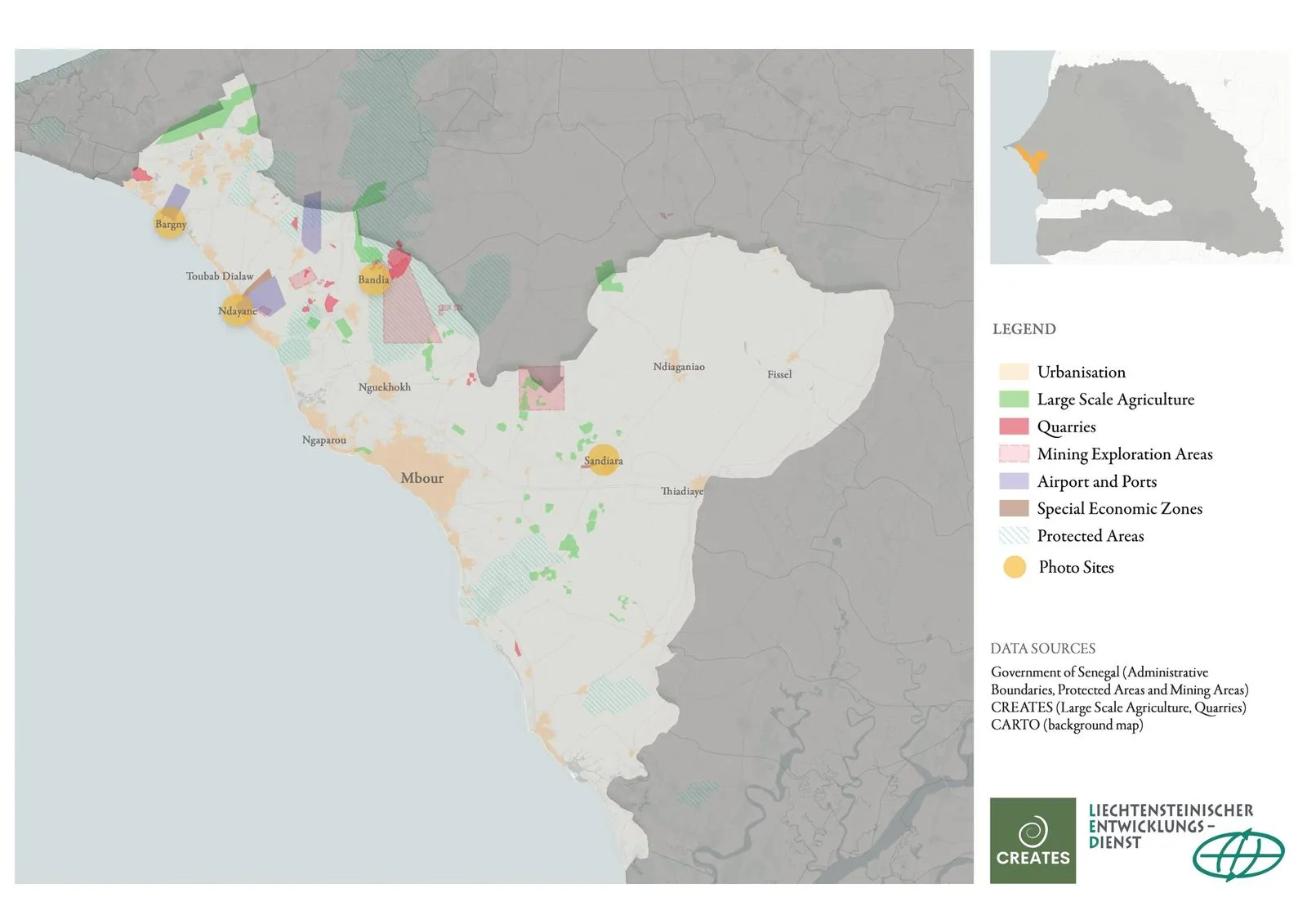
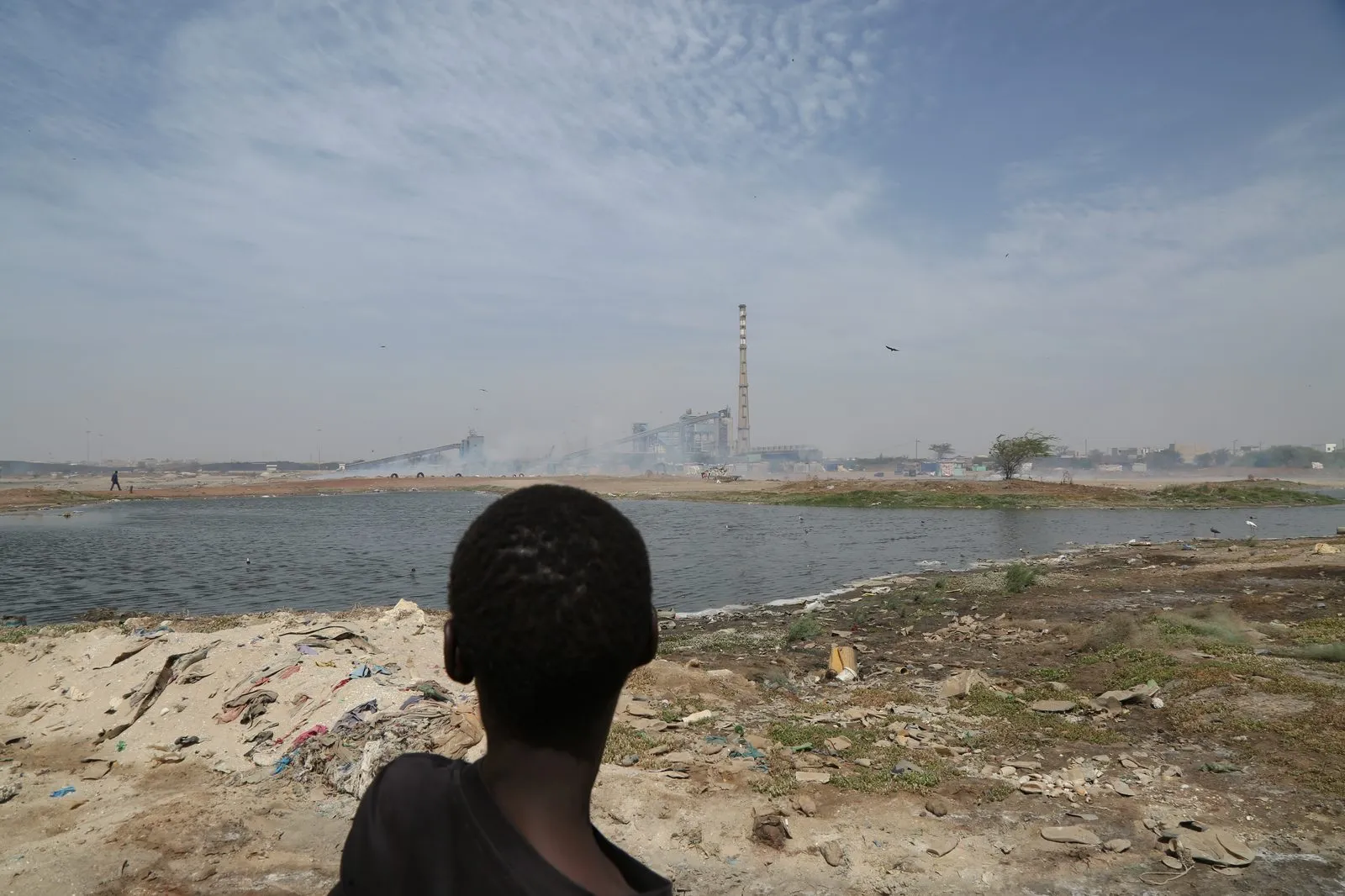
This photographic exhibition is part of the AgroVoiceS project, research conducted in Senegal at the intersection of political agroecology, social sciences, and artistic creation. It offers an alternative way of doing science: through images, symbols, and landscapes, rather than through academic discourse alone. Photographer Serge Boulaz's vision subtly captures the profound transformations of Senegalese agricultural and coastal territories - processes often made invisible: land grabbing, industrialisation of rural areas, exploitation of natural resources, and marginalisation of local populations. Here, landscapes become open-air archives, bearing the traces of political and economic decisions made far beyond these territories. The exhibition is structured around two ensembles: the hinterland of Sandiara and Bandia, marked by the expansion of agribusiness and mining extractivism, and the maritime front of Bargny and Ndayane, where climate crisis, heavy industrialisation, and land speculation intersect. When science becomes image, it gains sensory power.
In the Hinterland, the Open Veins of the Earth
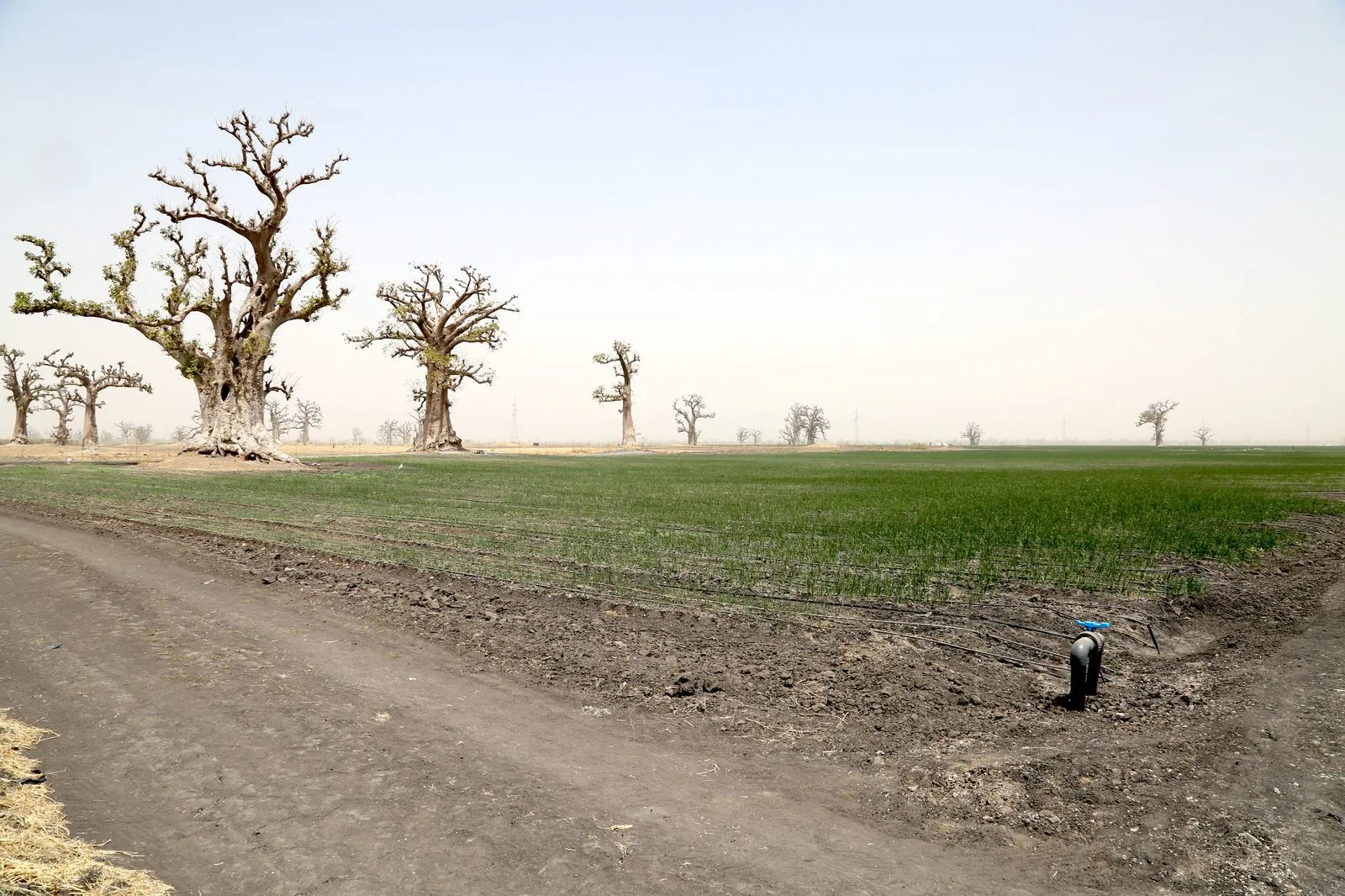
In the hinterland of Sandiara and Bandia, landscapes bear the superimposed traces of different forms of extraction. Watermelon fields, aligned and covered with plastic sheeting, draw on scarce water and the fertility of Sahelian soils to feed distant markets, while nearby, limestone extraction turns the earth to dust. Centuries-old baobabs, stripped bare by the dry season, watch over irrigated fields stretching as far as the eye can see - silent witnesses to a changing landscape, they border the new intensive crops destined for export. At the foot of a majestic baobab, a pile of used plastic sheets bears witness to the crop cycle. Through the Sahelian vegetation, industrial silhouettes loom in the haze - the shrubby savanna gives way to heavy infrastructure that transforms local limestone into building materials. These photographed landscapes tell the same story: that of a land slowly bled, whose open veins connect the Senegalese hinterland to the globalised circuits of agriculture and construction, at the cost of a silent exhaustion of the land and its inhabitants.
A Maritime Front, Between Sea and Fire
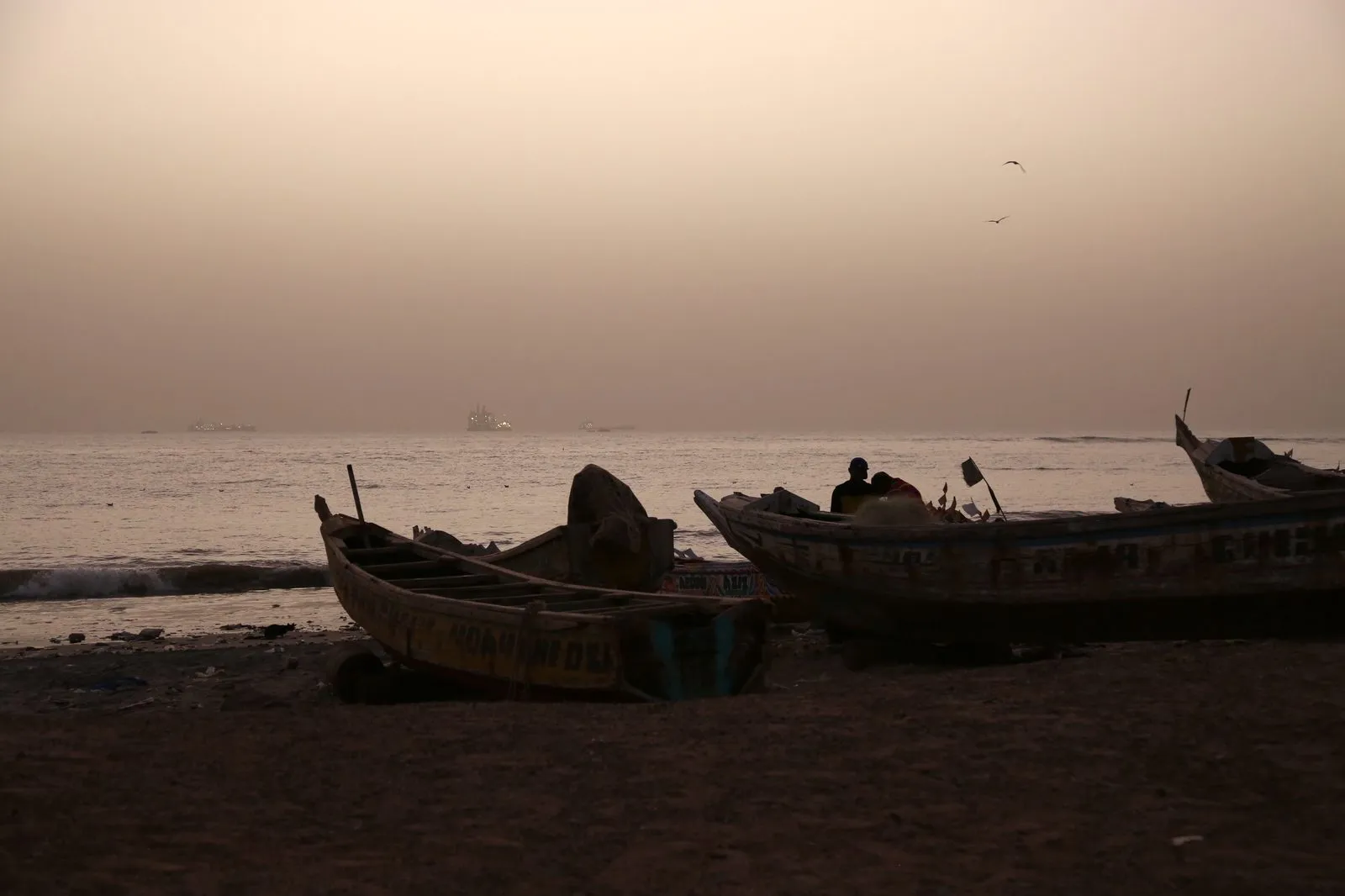
On the coast of Bargny and Ndayane, landscapes gradually close in on Lébou fishermen. The sea advances, weakening houses and nibbling at the shore, while the coal plant looms in the background, near the villages, with its smoke and unfulfilled promises of jobs. In the golden light of sunset, Lébou pirogues rest on the sand - on the horizon, the silhouettes of industrial vessels remind us of the competition weighing on artisanal fishing and marine resources. A child contemplates from behind the coal plant belching smoke above the lagoon. Between scattered waste and stagnant water, the landscape bears the stigmata of imposed industrialisation. On a beach strewn with debris and collapsed structures, a solitary silhouette advances through the mist - the remnants of old buildings bear witness to coastal erosion and the abandonment overtaking the shoreline. The air laden with particles, the sea depleted by the voracity of foreign boats, sacrifices life along the coast. Resources leave the shore, flows organise elsewhere, leaving behind communities facing uncertainty.
From Witnessing to Action: the Bey Diiwaan Project
The images in this exhibition are not merely a record of destruction. They are a call to action. In these very territories under pressure, another path is being forged. Bey Diiwaan, a project supported by the Liechtenstein Development Service (LED), works precisely in these landscapes in transition, engaging local communities in a territorial dynamic of agroecological transformation. Agroecology, as understood through Bey Diiwaan, is far more than a set of agricultural techniques. It is a holistic vision that addresses the root causes of the crises visible in these photographs: food sovereignty - reclaiming control over what is grown, how it is grown, and for whom; self-determination - empowering rural communities to shape their own futures; social and environmental justice - recognising that the communities bearing the heaviest burden of industrial pollution and land grabbing are those who have contributed least to these crises. Where the photographs show exhausted soils, plastic waste, and industrial smoke, Bey Diiwaan cultivates regeneration: restoring soil health, rebuilding biodiversity, strengthening local knowledge systems, and creating economic alternatives rooted in dignity rather than dependence. "Another agriculture is possible. Another future is within reach."